How the Garage Stopped Being About Cars and Started Being About Status
Ask most Americans what a house should have, and a garage ranks right up there with a kitchen and a roof. It feels like a given — as natural a part of home design as a front porch or a bedroom closet. But the attached garage, the kind that swallows the front of a house and determines where you enter your own home, is a surprisingly recent invention. And it didn't become standard because architects thought it was a great idea.
It became standard because the people selling cars needed somewhere to put them.
The Early Days of the Automobile and the Detached Shed
When cars first started appearing in American driveways in the early 1900s, nobody thought much about permanent storage. Early automobiles were stored in converted carriage houses, rented spaces at livery stables, or simple wooden outbuildings set apart from the main house. The separation made sense — early cars leaked oil, smelled of fuel, and occasionally caught fire. Keeping one attached to your living quarters was considered a genuine hazard.
The detached garage persisted well into the mid-20th century. It was a utility building, not a lifestyle statement. You walked out the back door, crossed the yard, and retrieved your vehicle. That was the routine. The idea that a garage should connect directly to your kitchen or hallway — that you should be able to go from car to couch without stepping outside — wasn't driven by homeowner demand. It was driven by something else entirely.
How Automakers and Developers Got Involved
As car ownership expanded after World War II, the housing industry and the auto industry found themselves with aligned interests. Developers building postwar subdivisions needed selling points that justified moving families to the edges of cities, far from public transit and walkable neighborhoods. Cars weren't just transportation anymore — they were the solution to that distance. And if you were going to sell families on car-dependent living, you needed to make the car feel like a natural, permanent, prestigious part of the home.
The attached garage did exactly that. It wasn't just storage. It was a signal. A house with an attached two-car garage communicated something about the family inside — that they had arrived, that they owned multiple vehicles, that they were participating in the American postwar dream on its own terms.
Developers quickly figured out that a prominent garage facade increased perceived value. Automakers, for their part, had every reason to encourage a culture where car ownership wasn't just common but architecturally baked in. By the 1960s and 70s, the attached garage had become so standard in new construction that buyers barely questioned it. It just looked like what a house was supposed to look like.
What the Garage Did to the Rest of the House
Here's the part most homeowners never think about: the attached garage didn't just add square footage. It reorganized the entire logic of the home.
In older neighborhoods built before the garage-forward era, the front door was genuinely the front door. It faced the street, it had a porch or stoop, and it was the place where life entered and exited the house. Neighbors saw each other coming and going. Streets had a social function.
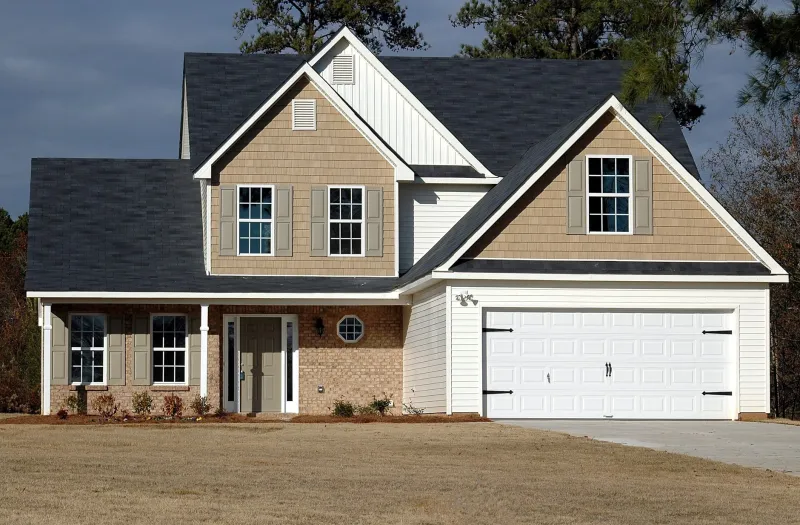
Once the attached garage moved to the front of the house, the front door became largely ceremonial. Most families enter their homes through a door off the garage — a side entrance, a mudroom, a utility hallway. The formal front door gets used for packages and guests who don't know any better. The street-facing facade of the house is now, in many American neighborhoods, just a wall of garage doors.
Urban planners have been quietly alarmed by this for decades. Studies on neighborhood social connection consistently find that garage-dominant street design reduces spontaneous neighbor interaction. When you drive in, press a button, and disappear into your house without ever walking a sidewalk, you simply encounter your neighbors less. The garage didn't just change architecture — it changed the texture of community life.
The Garage as American Overflow Space
There's another layer to this story that anyone who has tried to park in their own garage will recognize immediately: most American garages don't actually contain cars anymore.
Surveys consistently show that a significant portion of attached garages are used primarily for storage — boxes, bikes, seasonal decorations, old furniture, tools, and the general overflow of American consumer life. The two-car garage that was supposed to signal prosperity often signals something different: that the house itself doesn't have enough storage, and that the car — the original justification for the whole structure — has been bumped to the driveway.
The garage became a status symbol, and then it became a junk room. And the house was designed around it either way.
What This Means for Buyers Today
If you're shopping for a home, the garage is worth thinking about more critically than most buyers do. A large attached garage adds to a home's square footage calculation in some markets and not others. It affects your homeowner's insurance. It shapes how the house sits on the lot and how much yard you actually have. And if you buy in a neighborhood where garage-forward design dominates, you're also buying into a street environment that was designed around cars first and people second.
None of that is necessarily a dealbreaker. But it's worth knowing that the garage didn't become a fixture of American housing because homeowners demanded it. It became standard because it served the interests of industries that needed car ownership to feel inevitable — and permanent.
The common belief is that the garage is just a practical feature. The real story is that it's one of the most successful pieces of architectural marketing in American history.